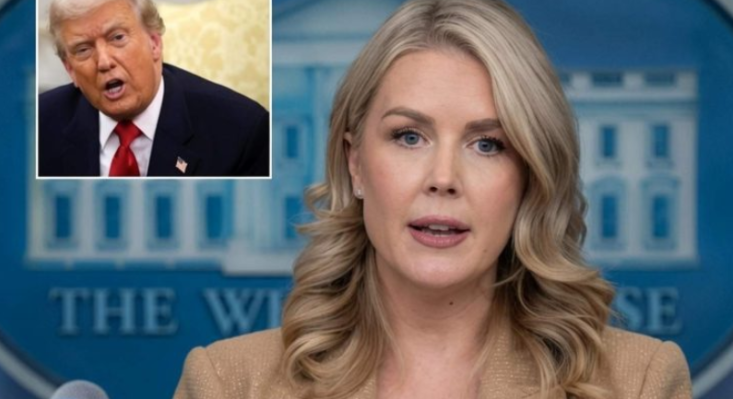
WASHINGTON — White House Press Secretary Karoline Leavitt defended the Trump administration’s changes to White House media access, arguing that the new approach is intended to expand access to a wider range of news organizations and journalists.
Speaking at an Axios event hosted by co-founder Mike Allen, Leavitt addressed questions about the administration’s decision to change how outlets are selected for the White House press pool. Allen raised concerns about whether limiting access for established outlets, including the Associated Press, could affect the historical record of the presidency.
“You have curtailed access to the Associated Press, which reaches half the world’s population every day. The most definitive photo of President Trump — the ‘Fight, Fight, Fight’ photo after the assassination attempt in Butler, Pennsylvania — was made by Evan Vucci, who is the chief photographer in Washington for the Associated Press. Do you worry about history being lost with these new restrictions?” Allen asked.
Leavitt rejected the characterization of the changes as restrictions.
“I don’t view them as restrictions. We view them as opening access to more outlets, more voices, more news, journalists and outlets,” Leavitt said.
She argued that a small number of established organizations should not have exclusive access to the White House briefing room or the 13-member press pool that covers the president’s movements.
“We shouldn’t have a few outlets who have a monopoly over the briefing room or over that 13-person press pool that covers the president,” Leavitt said. “And so we’ve actually ensured that more print outlets like Axios have a greater chance of being part of that 13-person press pool.”
Leavitt said thousands of outlets have White House press credentials, while hundreds regularly cover the administration.
“There are thousands of outlets who have White House press credentials. There are hundreds that actually show up every day and cover the beat,” she said. “Why should a single outlet have the privilege of being in that 13-person press pool every single day?”
According to Leavitt, the administration’s changes are intended to provide greater access to a broader range of media organizations and journalists.
“We’ve actually created more transparency, more accessibility, and greater access for a broad variety of outlets and a diversity of journalists,” she said.
Leavitt also argued that the administration’s approach has not prevented the public from receiving information about the president’s activities.
“I mean, we started this. I think you’re all still getting your news, right? You’re still hearing about what the administration is doing every single day, because we have good journalists who are in that room covering the president every single time,” she said.
Leavitt later criticized the role of the White House Correspondents’ Association in determining press access.
“I think that a small group of journalists who comprise the board of the White House Correspondents’ Association should not dictate who gets to go into the Oval Office and who gets to ride on Air Force One,” she said. “There should be equal access for all outlets.”
She added that the administration has continued to allow a wide range of media organizations to participate, despite political differences.
“And if we were trying, by the way, to create positive press for the president, if we were trying to make it easier on him or on the administration, we wouldn’t allow some of these fake news leftist outlets in,” Leavitt said. “But we continue to do that. No one has been restricted. We’ve just given more spots to more outlets and more voices.”
Leavitt concluded by saying the administration’s media strategy is focused on expanding the number and variety of outlets with access to the White House.
“It’s not about ideology. It’s just about increasing the wide variety of outlets that have access,” she said. “And we live in a digital age, and we’re recognizing that at the White House.”
She also pointed to Trump’s unconventional approach to media during his 2024 presidential campaign, saying the administration wanted to continue that approach after his return to the White House.
“The president ran a nontraditional media campaign, which propelled him back to the highest office in the land. And we felt it was our responsibility to continue that in our coverage at the White House,” Leavitt said.
Axios Report on Biden’s Media Engagement
The discussion also touched on Axios’ previous reporting about former President Joe Biden’s media engagement.
In July 2024, Axios published an analysis titled “Inside Biden’s media evasion,” based on data compiled by presidential scholar Martha Joynt Kumar. The analysis found that, as of June 30, 2024, Biden had participated in 164 press conferences and media interviews, compared with 468 for Trump at the same point in Trump’s first term.
The same Axios analysis reported that Biden had participated in 36 press conferences and 125 media interviews by that point. It also noted that Biden had engaged extensively in less formal question-and-answer sessions with smaller groups of reporters, a category in which he was second only to Trump among the recent presidents examined.
Axios’ analysis therefore documented a significant difference in the number of formal press conferences and media interviews involving Biden compared with several of his recent predecessors, while also noting that the broader picture included Biden’s frequent informal interactions with reporters.