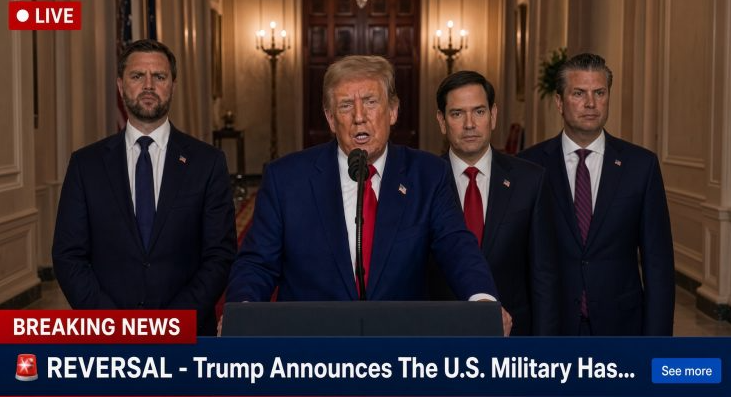
**WASHINGTON** — President Donald Trump said Thursday that the United States had “ended the war with Iran,” after he canceled additional planned military strikes and described talks as moving from battlefield pressure toward a possible diplomatic settlement.
Speaking on a tele-rally for Georgia Lt. Gov. Burt Jones, who is running for governor, Trump framed the shift as a turning point after days of heightened confrontation. “I don’t know if you heard, but we ended the war with Iran today,” he said.
Trump said any agreement would rest first on a commitment that Iran would not develop a nuclear weapon — an issue he called “95 percent” of the U.S. objective in the campaign. “They have agreed never to have a nuclear weapon,” he said, adding that Washington had insisted on that condition.
The announcement was more a declaration of intent than a completed treaty. Trump said the U.S. naval blockade affecting the Strait of Hormuz would remain in place until a formal agreement was finished. He indicated that negotiators would meet in Switzerland to lock down remaining terms, with some reports suggesting a signing could come within days. He also said he had discussed the emerging arrangement with Israeli Prime Minister Benjamin Netanyahu and other regional leaders. Netanyahu’s office later confirmed the conversation and said Israel welcomed Trump’s pledge that any final deal would tightly constrain Iran’s nuclear program and address other activities Israel regards as destabilizing. Israel was not described as a direct party to the talks.
In a social media statement, Trump said discussions had reached Iran’s highest levels of leadership and that the progress led him to cancel additional strikes that had been scheduled.
The Strait of Hormuz remains the hinge of the crisis and of global energy security. A large share of the world’s seaborne oil and liquefied natural gas moves through the narrow waterway between Iran and Oman. Any prolonged disruption raises costs for importers, insurers and shipping companies. Markets responded quickly to the prospect of reduced tension: European equities rose and oil prices fell as traders priced in a lower chance of further interruptions to Gulf shipments.
The diplomatic opening followed an intense military phase. Trump had previously warned that Iran would face severe consequences if talks stalled. In earlier social media posts he described Iranian military capabilities as badly damaged and said Tehran would pay a price for delay. U.S. Central Command said American forces had carried out additional self-defense strikes against targets inside Iran at the president’s direction. That sequence — strikes, threats of more strikes, then a sudden pause — is the backdrop against which Trump now presents diplomacy as the next stage.
The gap between rhetoric and paperwork is still wide. No final text has been signed. Enforcement, verification of nuclear pledges, the status of the Hormuz blockade, and how any deal would handle other regional flashpoints remain unresolved. Trump’s claim that the war is “over” therefore describes a halt in planned U.S. attacks and a political decision to bargain, not a completed peace.
If negotiators in Switzerland produce a signed agreement, the implications would be substantial: a possible reopening of the strait on agreed terms, a cooling of energy-market risk, and a new, if still fragile, framework between Washington and Tehran. If talks collapse, the military option Trump just set aside could return quickly. Officials and markets will watch the next several days for whether a pause becomes a settlement — or merely another interval between rounds of force.
Trump cast the nuclear restriction as both the purpose and the prize of the campaign. Allies and adversaries will judge the claim by what is written down, how it is monitored, and whether shipping through Hormuz actually resumes under conditions both sides accept. Until then, the president’s announcement marks a change in tone more than a change in facts on the water.