**Silent footage of Trump and a young man in a suit draws attention, but the clip itself offers no confirmed explanation**
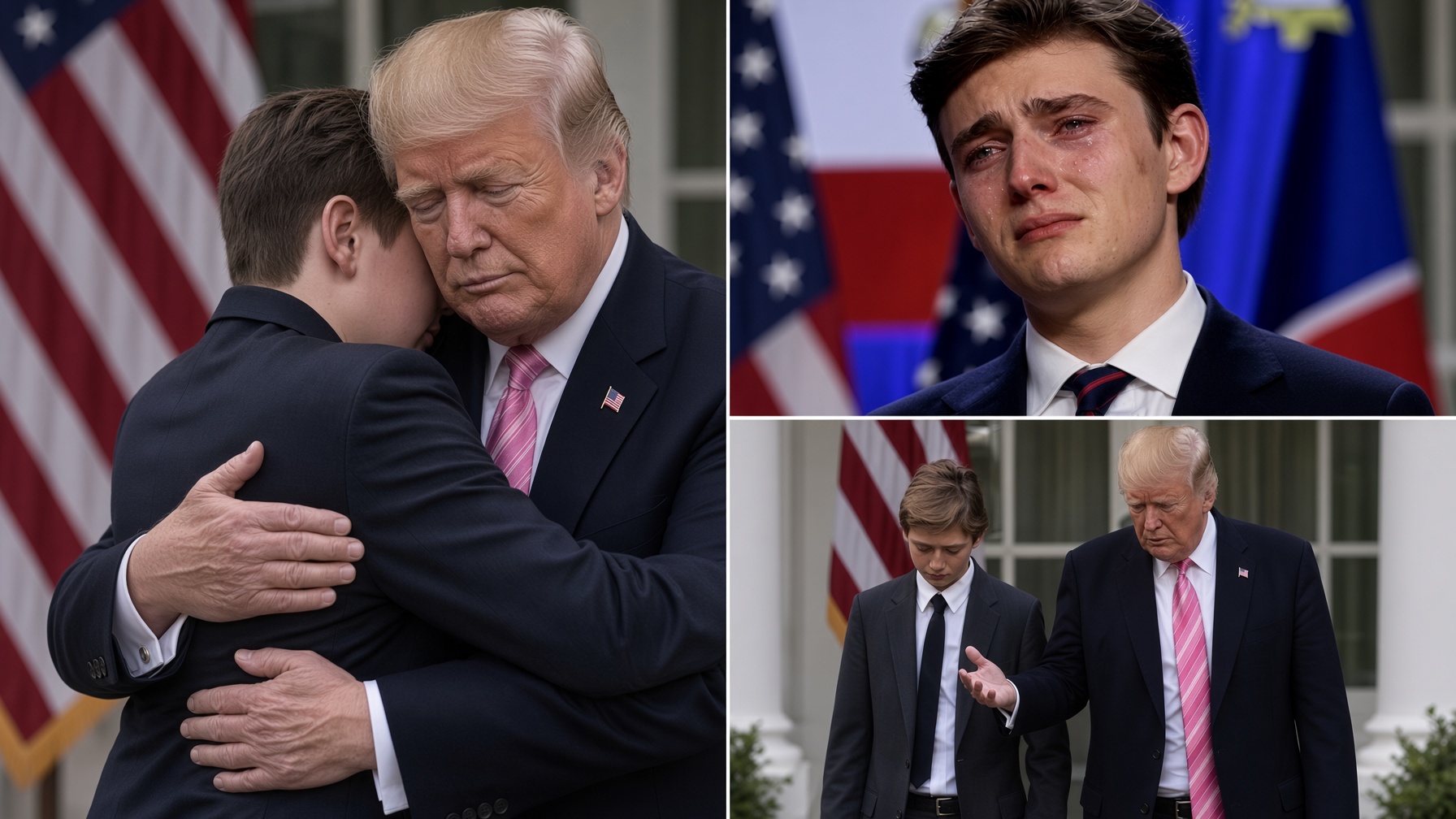
A short, wordless compilation circulating online shows President Donald Trump in a series of close, somber exchanges with a young man in a dark suit. The video is assembled as a split screen rather than a single continuous shot. It has no soundtrack, no caption identifying the date or location, and no on-screen explanation of what preceded the encounter. What it does show is limited and specific: an embrace, visible tears, and a brief walk side by side.
In the largest frame, Trump holds the younger man in a tight hug. The young man’s face is turned inward. His posture is slumped rather than formal. Trump’s hand is on his back in a gesture that reads, on camera, as consolation rather than ceremony. A second panel, cropped tighter, shows tears on the young man’s face. His eyes are wet; his expression is strained. A third panel shows the two walking together. Trump appears to be speaking and gesturing. The younger man stays close. The sequence is short. There is no handshake at the end, no podium, and no visible crowd reaction inside the frames provided.
Because the clip has no audio, nothing in the file itself establishes what was said. Viewers can see emotion. They cannot hear a conversation, a name, or a reason. That gap is the most important fact about the video as it stands.
The young man is tall, formally dressed, and appears to be in late adolescence or early adulthood. Online commentary has widely identified him as Barron Trump, the president’s youngest son. That identification is plausible on visual grounds and consistent with other public appearances in which Barron has been photographed in a suit beside his father. It is not, however, confirmed by a caption, a White House still, or a contemporaneous official statement attached to this particular compilation. Responsible reporting has to separate what the pictures show from what social media asserts.
The same caution applies to the cause of the tears. In recent years, public reporting has described several stressful episodes around the Trump family: assassination attempts against the president, threats discussed in foreign propaganda aimed at Barron, and Barron’s reported distress after the killing of conservative activist Charlie Kirk, whom he had met and admired. Those are documented events in the public record. None of them is labeled on this video. Linking the hug to any one of those moments would be inference, not evidence contained in the clip.
That distinction matters because silent political footage is easy to misuse. A hug can be read as grief, relief, apology, or simple family feeling. Tears can follow bad news, exhaustion, or a private conversation that never becomes public. Split-screen editing intensifies that effect. By placing the embrace, the close-up of the face, and the walk in one frame, the compilation tells a visual story of intimacy and strain. Editing is not the same as reporting. The arrangement invites a narrative. It does not prove one.
The production itself is straightforward. The images are sharp enough to show facial expression and clothing. The camera positions look observational rather than staged for a speech. There is little background detail: no identifiable seal, banner, or landmark that would pin the scene to a specific event. The lighting is even. The clips appear static, as if taken from longer recordings and then isolated. The absence of resolution is not a cinematic device so much as a missing record. The video ends as abruptly as it begins.
For news purposes, the clip is best treated as an incomplete primary source. It documents that Trump and a young man who resembles his son were filmed in an emotional exchange. It does not document a statement, a policy, or an “admission.” Earlier online claims that Barron, at 18, delivered a dramatic public confession were separately fact-checked as false. This footage should not be used to revive that genre of story.
What can be said with confidence is narrower. The president is shown offering physical comfort. The younger man is shown visibly upset. They remain together as they walk. The encounter looks private even though a camera was present. In a family that is both closely guarded and constantly photographed, that combination is familiar: a personal moment that becomes public the instant it is posted.
Until an official, the young man himself, or a dated original file with context is produced, the responsible headline is not a revelation. It is a description. A silent split-screen video shows Donald Trump embracing a distressed young man in a suit, then walking with him. The emotion is clear. The explanation is not.