**Obama’s remarks on Trump’s “obsession” reignite a long-running political feud**
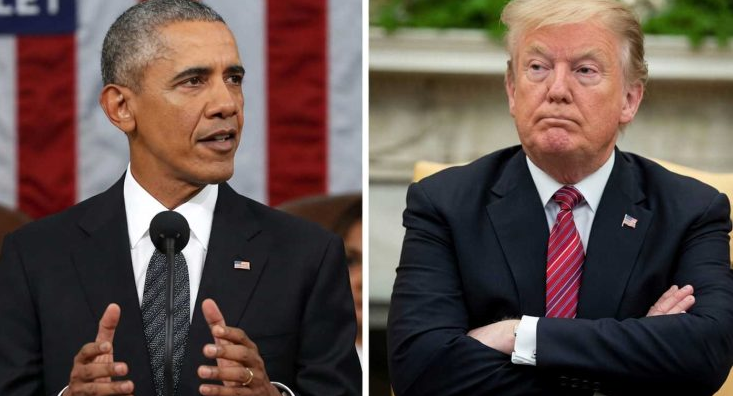
A conversation that began as a wide-ranging podcast interview has become the latest flashpoint in the long and uneasy relationship between former President Barack Obama and President Donald Trump. Clips from the appearance spread quickly after the episode of *All the Smoke* was released in late June, turning a few minutes of commentary into a broader argument about tone, focus, and how political messages travel in a fragmented media environment.
The interview, recorded at the newly opened Obama Presidential Center in Chicago with hosts Matt Barnes and Stephen Jackson, covered basketball, leadership, and public life. It shifted when Barnes asked how Obama handles years of criticism from Trump and what he called a continuing “fascination” with Obama and his family. Obama did not dodge the question. “You got to ask him what it is — the obsession,” he said. “I obviously, you know, have a room in his head — a suite — in his head.”
He drew a contrast with his own time in office. A president doing the job, he argued, faces “five, ten things that are real hard” every day and cannot afford to measure a predecessor’s daily output. “They’re gone. I’ve got work to do,” he said. Persistent comparison, in his telling, is “a strange thing” and a sign that someone is “not focused on the American people and the job they’re supposed to do.”
Obama also said Trump speaks differently in person than online. The two have been seated near each other at public events, including the funeral of former President Jimmy Carter. “If this — whoever you were talking about — was in front of me, which has happened a couple times, he don’t talk like that. Cause he knows better,” Obama said. He blamed “the filter of the phone” for remarks that, he suggested, would not survive a face-to-face exchange.
Supporters on both sides treated the same lines as confirmation of what they already believed. Allies of Obama heard a former president stating a pattern many Democrats have long alleged: that Trump returns to Obama even when the subject at hand is Iran policy, housing, or infrastructure. Trump has repeatedly attacked the 2015 Iran nuclear deal as one of the worst agreements in American history and has used Obama’s full name as a political marker. Tracking analyses cited after the podcast noted hundreds of public mentions of Obama across a single year of Trump remarks.
Trump’s defenders heard something else: a former president who left office nearly a decade ago still inserting himself into the current administration’s record. A White House spokesman responded that Obama would “go down as one of the most dishonest, divisive, and destructive Presidents in history.” For that audience, Obama’s tone was not measured candor but an unsolicited lecture from a rival whose own foreign-policy record remains contested.
The speed of the reaction mattered as much as the words. Short clips — the “suite in his head” line, the claim that Trump “knows better” in person, the jab about presidential focus — circulated far beyond the full conversation. That is now the default path for political speech. A sit-down that also included basketball talk and reflections on screening out “noise” was reduced, in many feeds, to a few seconds of confrontation. Headlines, commentary, and reaction videos filled the space before most viewers had heard the surrounding questions.
The episode also illustrates how traditional and social media now operate as one system. A podcast recorded for a sports-and-culture audience became national political news within hours. Tone and delivery carried as much weight as policy. Obama’s relaxed cadence and understatement read to some as composure; to others it read as condescension. Trump’s habit of answering questions by invoking Obama reads to supporters as accountability for a prior administration and to critics as distraction.
None of this is new. The two men have been foils since the 2011 White House Correspondents’ Dinner and the birther controversy that preceded it. What has changed is the velocity. An interview no longer ends when the recording stops. It is sliced, captioned, and argued over until the next clip arrives. In that cycle there is little room for the full context of a conversation that was never designed as a debate.
The moment is less a turning point than a reminder. Political figures now speak to two audiences at once: the people in the room and the millions who will see only a fragment. Words still matter. So does the way those words are packaged, shared, and interpreted. The latest exchange between Obama and the orbit around Trump shows how quickly a few sentences can become a referendum — not only on two presidents, but on the media system that now carries almost every public remark.