**ABC stands by Jimmy Kimmel after Melania Trump “expectant widow” joke as White House demands his firing**
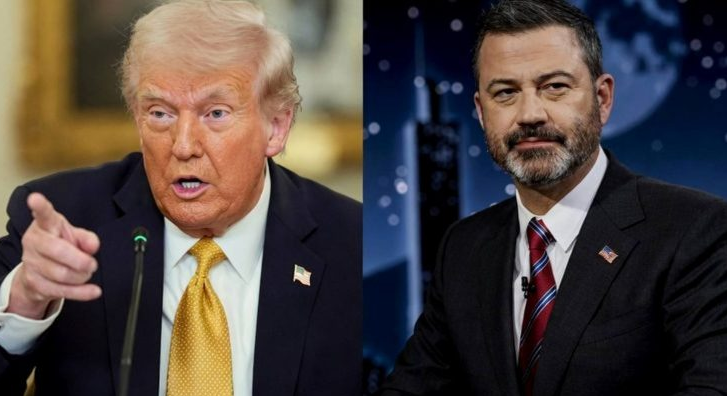
WASHINGTON — A late-night comedy bit that aired days before a security scare at the White House Correspondents’ Association dinner has become the latest flashpoint between President Donald Trump, first lady Melania Trump and ABC’s Jimmy Kimmel.
On the April 23, 2026, episode of *Jimmy Kimmel Live!*, Kimmel staged a mock version of the dinner after organizers chose a mentalist rather than a comedian as the featured performer. In the parody, he addressed a simulated first lady and said she had “a glow like an expectant widow.” Other jokes in the segment targeted the president’s age, thin skin and the couple’s public image.
Two nights later, the actual dinner in Washington was disrupted when an armed man attempted to enter the ballroom. The president and first lady were evacuated. After clips of Kimmel’s earlier joke circulated again, the White House framed the line as more than roast-style humor.
**White House response**
On April 27, Melania Trump posted that Kimmel’s “hateful and violent rhetoric is intended to divide our country,” that his monologue “isn’t comedy,” and that “people like Kimmel shouldn’t have the opportunity to enter our homes each evening to spread hate.” She called him “a coward” who “hides behind ABC” and said it was “time for ABC to take a stand.”
President Trump followed on Truth Social, calling the remark “really shocking” and “far beyond the pale.” He accused Kimmel of using a “fake video” of the first lady and their son Barron, described the joke as a “despicable call to violence,” and said Kimmel “should be immediately fired by Disney and ABC.”
The first lady did not stay silent, contrary to some early social-media summaries of the episode. Her statement preceded the president’s and set the terms of the public demand on the network.
**Kimmel’s defense**
Kimmel addressed the controversy on his April 27 broadcast. He said the line was “a very light roast joke about the fact that he’s almost 80 and she’s younger than I am,” and “not, by any stretch of the definition, a call to assassination.” He expressed sympathy for those at the dinner who experienced a frightening night, while rejecting the idea that a joke delivered three days earlier caused the security incident. He also turned Melania Trump’s language back on the White House, saying hateful rhetoric should be rejected and suggesting she start that conversation with her husband.
**What ABC actually did**
ABC did not announce a temporary suspension of *Jimmy Kimmel Live!* over the Melania joke. A network source told Page Six the company was “sticking by” the host and had no plan to suspend him, fire him or cancel the show, and that taping would continue as usual.
That matters because the show *was* pulled off the air in September 2025 after Kimmel’s comments about the killing of conservative activist Charlie Kirk. At that time, FCC Chairman Brendan Carr publicly pressured broadcasters. ABC and some affiliates briefly took the program down; Kimmel returned days later after a free-speech backlash. The April 2026 fight revived that history even though the network’s immediate response this time was different.
Federal regulators still loomed in the background. After the widow joke, the FCC directed ABC to file broadcast-license renewal applications early — licenses that were not otherwise due until 2028 — a move that mixed a prior DEI-related inquiry with fresh complaints about Kimmel. Critics called it political pressure on a private news-and-entertainment company; supporters said public-airwave licensees should face consequences for content they air.
**Comedy, timing and a security scare**
The dispute is not only about one sentence. It is about timing. A death-adjacent joke about a sitting president’s spouse, followed within 48 hours by an armed attempt to reach a room full of political leaders, gave opponents a narrative that satire had crossed into something uglier. Defenders note that Kimmel could not have known about Saturday’s incident when he taped Thursday’s show, and that presidential roasts have long used mortality, age and marital distance as raw material.
Late-night television has spent a decade tightening around partisan audiences. Hosts who once aimed jokes at whoever occupied the White House now operate in an environment where clips travel faster than context, advertisers watch social sentiment in real time, and regulators talk openly about affiliate licenses. Whether a line is “just a roast” or “violent rhetoric” is no longer decided only in the writers’ room. It is decided on X, Truth Social and in corporate risk meetings.
Advertiser unease is real in this market even when a network does not pull a show. Brands do not need a formal boycott to quietly shift spend. That commercial pressure, more than a single monologue, is what keeps entertainment lawyers and standards departments on overnight calls. The original circulating account of this episode overstated ABC’s programming response; it did not invent the financial and political leverage surrounding late night.
**The larger argument**
The core questions are familiar and unresolved. Where does political satire end and a personal attack begin? Does a first lady’s public role make her fair game in the same way as an elected official? What duty does a broadcast network have when a joke is later read against an unrelated security threat?
Kimmel’s camp answers that age-gap jokes are stock late-night material and that treating them as assassination talk is a bad-faith escalation. The Trumps answer that major networks should not platform lines that sound like they are waiting for a widow. Both sides claim they are defending standards — one of speech, the other of decency.
As of late April 2026, *Jimmy Kimmel Live!* remained on ABC. The White House had not dropped its demand. The FCC had inserted itself into the license calendar. And the clip of a tuxedoed host telling a first lady she glowed like an expectant widow had become another data point in a longer fight over who gets to police American comedy — comedians, networks, audiences or the government that licenses the airwaves.