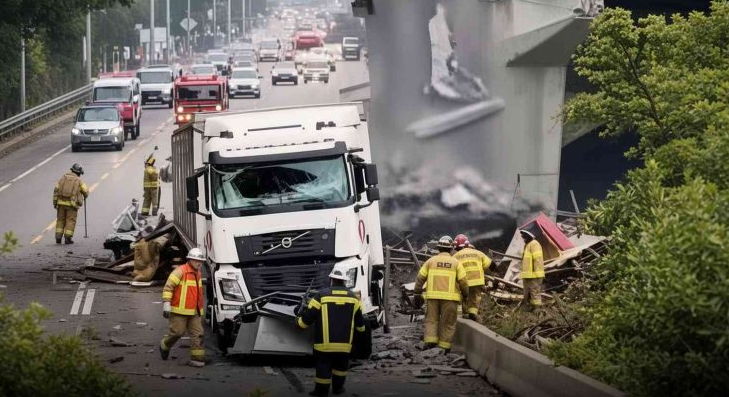
**RICHMOND, B.C.** — Southbound Knight Street was shut for hours Friday after a commercial dump trailer, travelling with its bed raised, struck the Cambie Road overpass just south of the Knight Street Bridge, shearing the cab from the trailer and prompting a full structural review of the crossing.
The collision happened about 7:15 a.m. Pacific Time. Investigators said the truck was towing a dump trailer in the vertical position when it failed to clear the span. The impact tore the tractor unit free; police later found the cab some distance down the road while the trailer remained lodged against the concrete and signage. No injuries were reported.
Richmond RCMP and the city’s Road Safety Unit took the lead, working with the Ministry of Transportation and Infrastructure to inspect the overpass, the Knight Street bridge deck and nearby structures for cracks, displaced joints or compromised beams. Officials offered no immediate reopening timeline and urged drivers to use detours as congestion built across Richmond and into Vancouver.
“A major structure has been struck. It needs to be examined by engineers,” Richmond RCMP Cpl. Dennis Hwang said at the time. Police later described the driver as uncooperative with investigators.
The City of Richmond noted that the highway section is under provincial jurisdiction but sent municipal engineers to assist. By late morning the trailer bed was still pressed against the span while crews cleared debris and secured the site. Cambie Road between Viking Way and Jacombs Road was also closed for a period.
Provincial records later listed the carrier as All Right Trucking-99 Ltd. and classified the cause as driver error: vehicle equipment not lowered for transport. Violation tickets were issued.
### A familiar problem on B.C. highways
The crash was not an isolated event. Over-height commercial vehicles have struck bridges and overpasses across the Lower Mainland and Fraser Valley with unsettling regularity. In the year before this incident, officials recorded multiple similar collisions, including a high-profile strike in Langley. Common factors include raised dump beds, poorly measured loads and incomplete pre-trip checks.
Industry groups and engineers have pointed to a mix of human error and infrastructure issues. Some incidents involved missing or outdated clearance signs; others followed resurfacing work that reduced available height. Aging structures and growing freight volumes have increased the stakes.
The British Columbia Trucking Association has called for a more systematic response, including over-height detection systems that use lasers or infrared sensors to warn drivers before they reach low spans. Fleet operators have been pressed to tighten training so drivers confirm trailer-bed position, verify posted limits and lock hydraulic systems before travel.
Transportation specialists argue that incident data should drive investment: mapping repeat locations, prioritizing high-risk corridors and feeding clearance information into commercial GPS systems rather than relying solely on roadside signs.
### What engineers look for after a strike
Even when an overpass looks intact, impact can damage internal reinforcement, loosen joints or reduce long-term capacity. Standard practice after a strike includes visual inspection, non-destructive testing and, when needed, load analysis before full traffic returns. Temporary lane restrictions or reinforcement sometimes follow.
In this case the structure was later deemed safe for vehicles, but damage to the sidewalk and a north-side lane kept those areas closed pending repairs. City documents subsequently put the cost of permanent work—removing damaged concrete, replacing structural elements, curbing, handrails and signage—at about $1.4 million. Richmond sought recovery from the insurer because a third party caused the damage. Overnight lane closures on Knight Street were later used to complete the work.
### Traffic, costs and the wider network
Knight Street is a major commercial artery linking Vancouver, Richmond, Delta and the Fraser Valley. Closing southbound lanes forced traffic onto No. 5 Road, Shell Road and other secondary routes, stretching commutes and delaying deliveries. Businesses that depend on just-in-time freight absorbed extra fuel and labour costs; public agencies absorbed inspection and eventual reconstruction expenses.
Repair bills for comparable overpass strikes in British Columbia have reached into the millions, split among insurers, carriers and public infrastructure budgets. Officials repeatedly note that prevention is cheaper than reconstruction.
Proposed measures include:
– Over-height detectors that trigger flashing warnings or alerts.
– Fleet telematics that flag restricted-height routes.
– Mandatory height checks as part of pre-trip inspections, especially for dump and hydraulic equipment.
– Regular audits of posted clearances after paving or structural work.
Experts describe these tools as part of a broader “safety ecosystem” that also requires accountability from drivers, carriers and highway authorities. No single device eliminates every strike.
### Policy questions that linger
The Richmond collision added to a longer debate about how Canada maintains freight corridors as trucks grow larger and infrastructure ages. Some jurisdictions in the United States already require detection systems on key commercial routes. Canadian proposals include embedding official clearance data in navigation software used by professional drivers.
Public-safety advocates also stress faster, clearer communication when a span is closed: expected inspection times, detour maps and updates that keep confidence in the network from eroding.
The Knight Street incident caused no deaths or serious injuries. It did, however, illustrate how one unsecured dump bed can halt a regional corridor, consume engineering and police resources, and leave a multimillion-dollar repair bill. For provincial and municipal officials, the episode reinforced the case for detection technology, better signage and tighter commercial-vehicle enforcement. For the trucking industry, it was another reminder that pre-trip discipline is not optional.
Heavy-haul traffic remains essential to the provincial economy. Its safe coexistence with aging overpasses will depend on shared responsibility—technology where it works, training that is actually followed, and inspections that treat every strike as a warning rather than an inconvenience. The lanes reopened. The pattern of over-height collisions has not yet been broken.