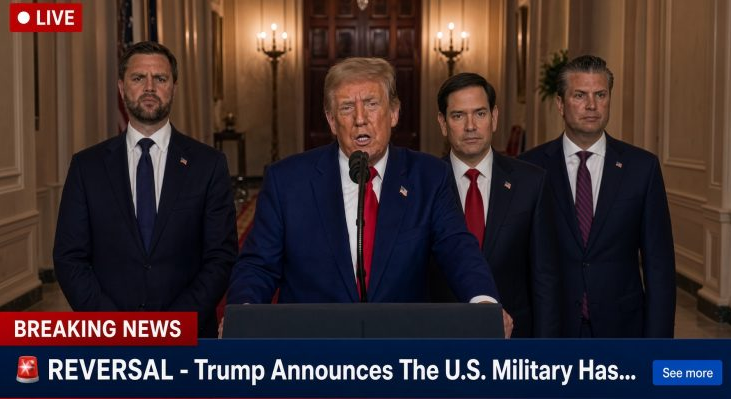
**WASHINGTON** — President Donald Trump said Thursday that the United States had “ended the war” with Iran after he canceled additional planned military strikes, presenting a sharp turn from battlefield pressure toward talks he said could produce a formal agreement within days.
Speaking at a tele-rally for Georgia Lt. Gov. Burt Jones, a candidate for governor, Trump told supporters the two countries had reached a point at which diplomacy could replace further attacks.
“I don’t know if you heard, but we ended the war with Iran today,” he said.
The president said a central condition of any settlement would be Iran’s pledge never to develop a nuclear weapon. He described that demand as the overwhelming share of Washington’s objective.
“They have agreed never to have a nuclear weapon,” Trump said, calling the issue “95 percent” of the purpose of the military campaign.
He stopped short of declaring the crisis fully closed. A U.S. naval blockade affecting traffic linked to Iranian ports and the Strait of Hormuz would remain in place, he said, until a written deal was completed.
### Talks pointed toward Switzerland
Trump said U.S. and Iranian representatives would meet in Switzerland to lock in the arrangement. He indicated a signing could come quickly. In a social media post, he said discussions had reached Iran’s highest levels of leadership and that progress led him to cancel strikes scheduled for that evening.
He said he had briefed Israeli Prime Minister Benjamin Netanyahu and other regional leaders. Netanyahu’s office later confirmed the call and said Israel welcomed Trump’s insistence that any final accord impose tight limits on Iran’s nuclear program and address other activities Israel considers destabilizing. Israel was not described as a party to the talks.
Iran did not immediately issue a matching public confirmation of a completed deal, leaving a gap between the president’s announcement and Tehran’s official record.
### Markets watch Hormuz
The Strait of Hormuz remains one of the world’s most important energy choke points. A large share of seaborne oil and liquefied natural gas shipments passes through the narrow waterway, so any prolonged disruption quickly registers in prices and insurance costs.
Investors treated the pause in strikes as a relief signal. European equities rose as traders weighed a lower risk of an extended cutoff of Gulf supplies. Oil prices fell on expectations that shipping through the region might stabilize if talks hold.
### From strikes to a cease-fire bid
The announcement followed days of intensified fighting. Trump had warned Iran of severe consequences if talks failed, saying its military had already been badly damaged. U.S. Central Command said American forces had carried out additional self-defense strikes inside Iran at the president’s direction.
That sequence now gives way, in Trump’s telling, to negotiation over a longer-term settlement. The immediate questions are familiar and unresolved: the exact nuclear commitments, how they would be verified, what happens to sanctions and frozen assets, and when — or whether — the Hormuz-related blockade would be lifted.
If negotiators produce a signed text, the shift could ease pressure on energy markets and regional security. If talks stall, the cease-fire Trump described could prove brief. For now, he is framing diplomacy as the next phase of the conflict while governments and markets wait to see whether a pause becomes a settlement.